Fresh Lines
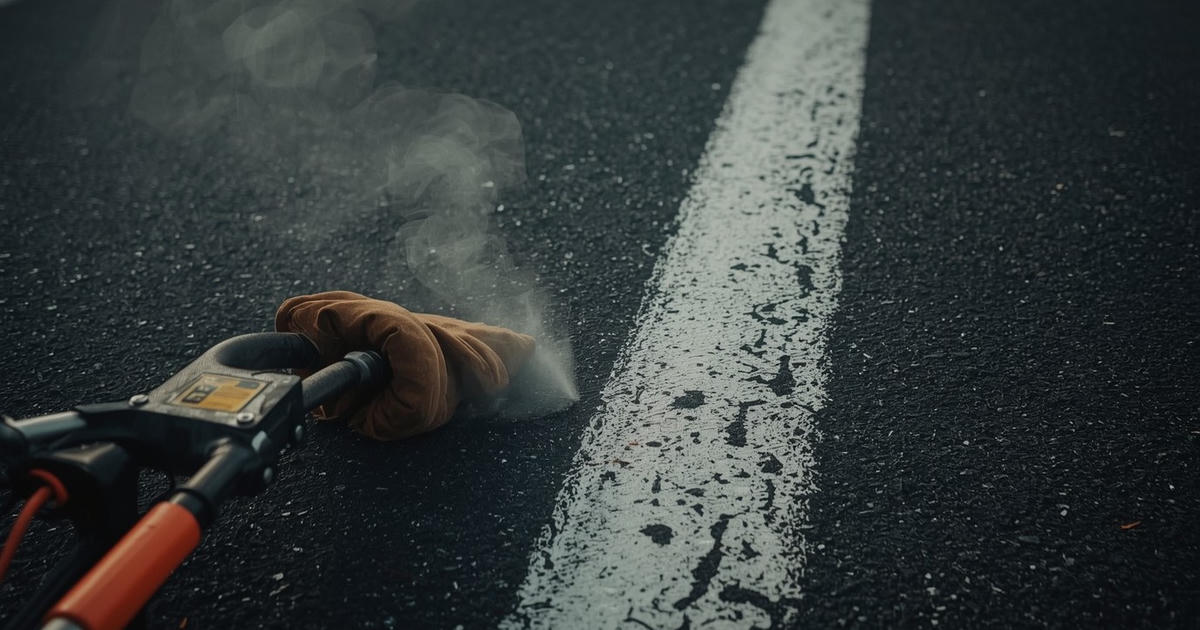
Elm Street is down to one lane again. The flagger has the sign turned to STOP at seven in the morning, and there's a guy in an orange vest leaning on a shovel while a paver lays down a fresh black strip where the old asphalt used to be. New paint goes on after. Bright white thermoplastic, crisp edges, the kind that looks wet for a week.
I've lived in Jenks for a year. Elm has been like this the whole year. So has Highway 75. So has every road north and south of my house, and most of the ones east and west. You learn the detours because the detours are the route.
My friend Mark told me his son said it first: the normal state of a road is under construction. Finished is the abnormal state. We were driving down Elm when he said it, which was almost too on the nose. Once you hear it you can't unhear it. The torn-up road is the road you actually know. The cones, the flagger, the lane shift, the rumble strip where the seam hasn't been ground flat yet. That's not the interruption. That's the road.
The condition, not the exception
We talk about roads like they get finished and then something goes wrong. A pothole opens, a winter cracks the surface, a truck spills something. The frame is: completion is the default state, and maintenance is what happens when the default breaks down.
It's the other way. Maintenance is the condition. Completion is the season between the last crew leaving and the next one showing up. If a road is being used, it is being worked on, basically forever, in some rolling combination of patching, sealing, repainting, widening, and grinding. The "done" road is a snapshot taken between two construction projects, and the snapshot fools you into thinking the snapshot is the thing.
Same with the people you're closest to. The healthy relationship is not the one without friction. It's the one in continuous low-grade repair. You patched something last month. You'll patch something else next month. Nobody's filing a report about it.
The equilibrium road
With my closest friend I see him every day. We work out together, our kids are the same age, we go to events together, we talk about the things we're reading. There's a lot moving back and forth and the road is wide enough to carry it. We're constantly making small repairs without noticing. That's what the maintained road looks like from inside. It just works, and there's nothing to describe until it doesn't.
When the road gets outgrown, you widen. This is awkward every time. In a romantic relationship you start with a footpath, and any wrong move feels like it could wash the path out. Too many texts and you seem desperate. The wrong invitation and the whole thing collapses. You have to coordinate the build-out in discrete jumps, and the jumps don't feel gradual when you're in them.
With Mark it went in steps. We were acquaintances at a men's Bible study a friend had brought me to. Then I got invited into a discipleship program he was running. Then he mentioned a hill training thing his mountain group did, and I said I'd start training with him. Then daily workouts. Then our kids hanging out. Then events together as families. Each jump had its own awkward "do we actually do this" moment. Each one happened because the old path couldn't hold it.
When the traffic leaves, the road decays. Nobody decided to neglect it. The use just stopped summoning the upkeep, because there was nothing to summon it for. This is the part that confuses people about relationships. They think the decaying relationship is the overused one, the one that got worn out. It's almost never that. It's the one where the traffic left and the maintenance had nothing to maintain.
The last trip on a dying road
I had a friend years ago, the kind I'd known for a long time, where the traffic had basically already left. He called me from a bus station once. He was in a rough spot, mostly of his own making, and he wouldn't take any of the help that would have actually helped. What he wanted was a ride to a seedy motel in a bad part of town, the kind of place with boarded-up strip centers across the street and parking lots full of glass. I offered to take him to his parents. I offered to call his dad. He wouldn't have it. So I put my kids in the car, drove him to the motel, said something like "bye," and drove home.
That ride was a freshly poured stretch of road that I drove on exactly once, to do a thing I didn't want to do, for a relationship that had no other traffic on it. I didn't hear from him for a couple of years after. The road went back to whatever it had been, which was nothing.
The point isn't that I shouldn't have given him the ride. The ride was the right call in the moment. It just didn't make the road a road. One trip doesn't summon a route into being. You can do the right thing for someone you no longer have a connection with and have it still be the last thing.
The vanity road
Here's the one that took me longer to see. There's a worse case than the road that decayed when the traffic left. It's the road that's still getting repaved on schedule, with fresh thermoplastic lines, and no tires.
That road isn't honest. It looks like virtue from the air. Crisp lines, clean shoulder, new signs. But nothing is driving on it. The upkeep isn't being summoned by use. It's being summoned by the maintainer's need to be a maintainer. You repave because that's what someone with a road does. The model isn't the traffic. The model is the other groundskeepers.
You can't paint a road into being needed. Use is what calls upkeep into being, and it only runs the one direction. Fresh lines don't generate the trips that would justify them. They just sit there looking like they should.
In a relationship, that's the standing dinner with someone you no longer share anything with, the birthday call you make because you've always made it, the check-in text that doesn't open anything because there's nothing to open. It's not malicious. It's not even insincere in the moment. It's just that the upkeep is for you, not for the connection. You're keeping the lines fresh so you can be the kind of person who keeps the lines fresh.
The vanity road is harder to see than the abandoned one because it photographs well. Nobody looks at fresh paint and asks if anybody drives there.
Some roads are supposed to go to gravel
A few hundred miles of paved U.S. road have been ground down and returned to gravel in the last several years, because the traffic didn't justify the cost of keeping them paved. I read that and my first reaction was that the number seemed low. There are a lot of roads out there that nobody really needs anymore. The towns they served got bypassed. The mill closed. The route changed.
Grinding a road back to gravel isn't a failure. It's an admission. The traffic isn't there. Pretending it is, by repaving on the old schedule, would be the failure.
I have a cousin my brother and I were close to for a while. He went one way, we went another, and at some point it became clear we couldn't keep him in our regular rotation without absorbing things we couldn't absorb. That road went to gravel. I don't think it should have stayed paved. I don't think anybody did anything wrong by letting it.
I also have a friend named Corry from middle school, one of the kindest people I've ever known, where I let the road go to gravel and I shouldn't have. He kept calling for a while. I didn't pick up. The reasons were mine and they were real at the time, and they weren't about him. Eventually he stopped calling. The road's still there. It's grass now. I think about him.
So I'm not standing outside this. I've let roads go to gravel that I shouldn't have, and I've poured fresh asphalt for one ride to a motel I didn't want to drive to. The diagnostic isn't a verdict on anyone. It's just a way of looking at the lines.
The failure isn't the empty road growing over. The failure is the empty road with fresh paint on it. If you're tired, check which one you're maintaining, and for whom.